Censorship by the Church of Voltaire and Rousseau
Blame Voltaire, Blame Rousseau! : Clerical Censorship of the philosophes that inspired Gavroche
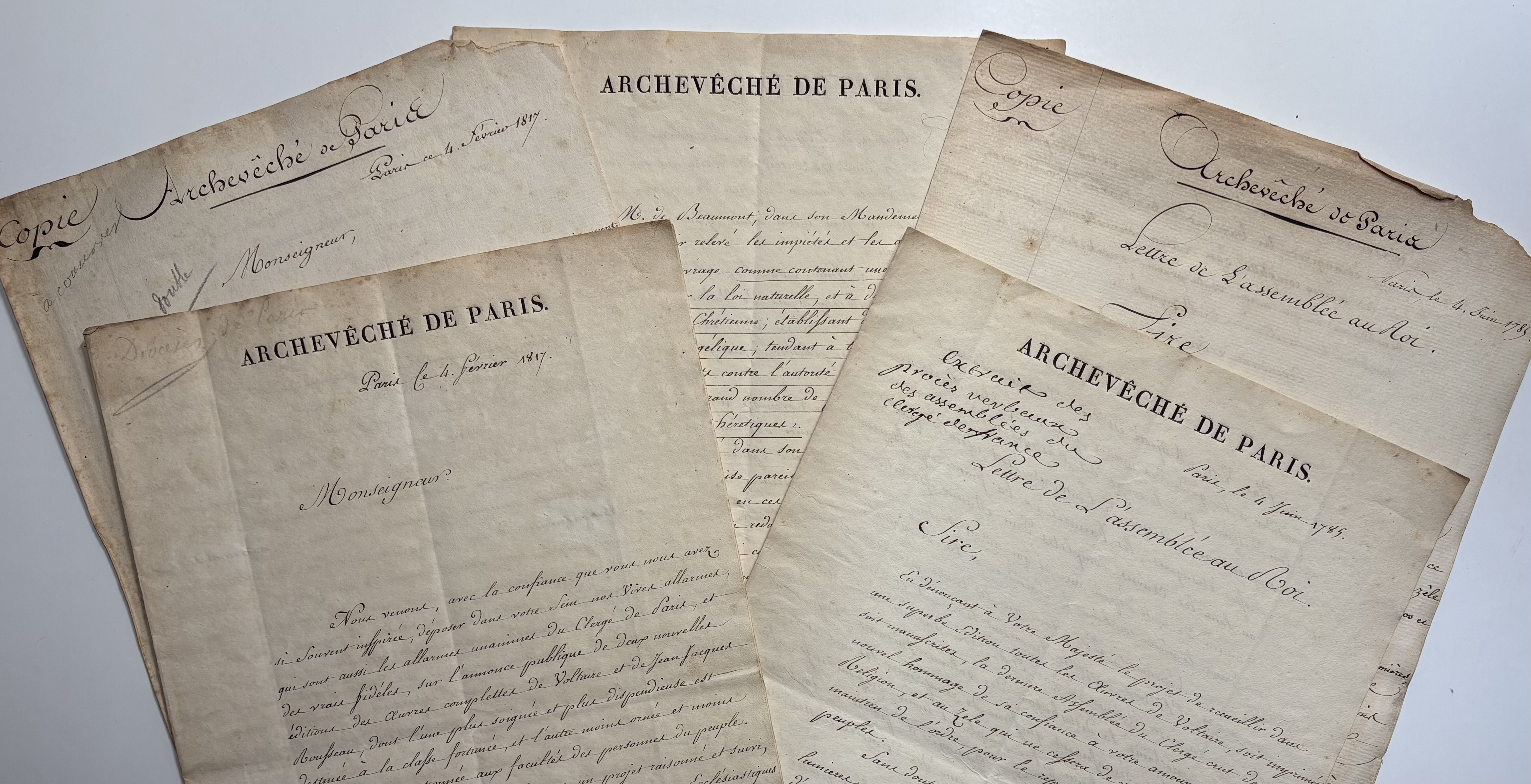
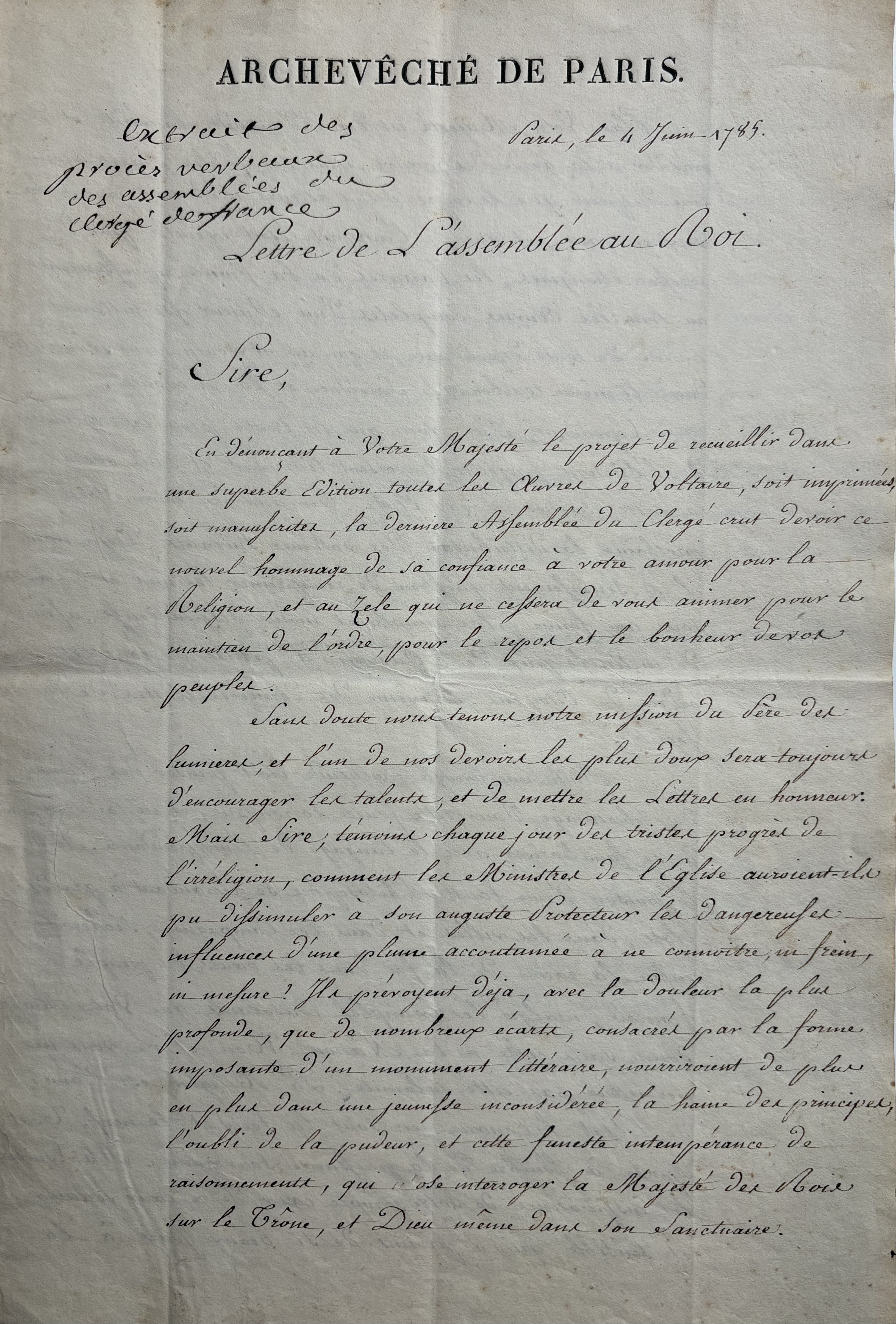
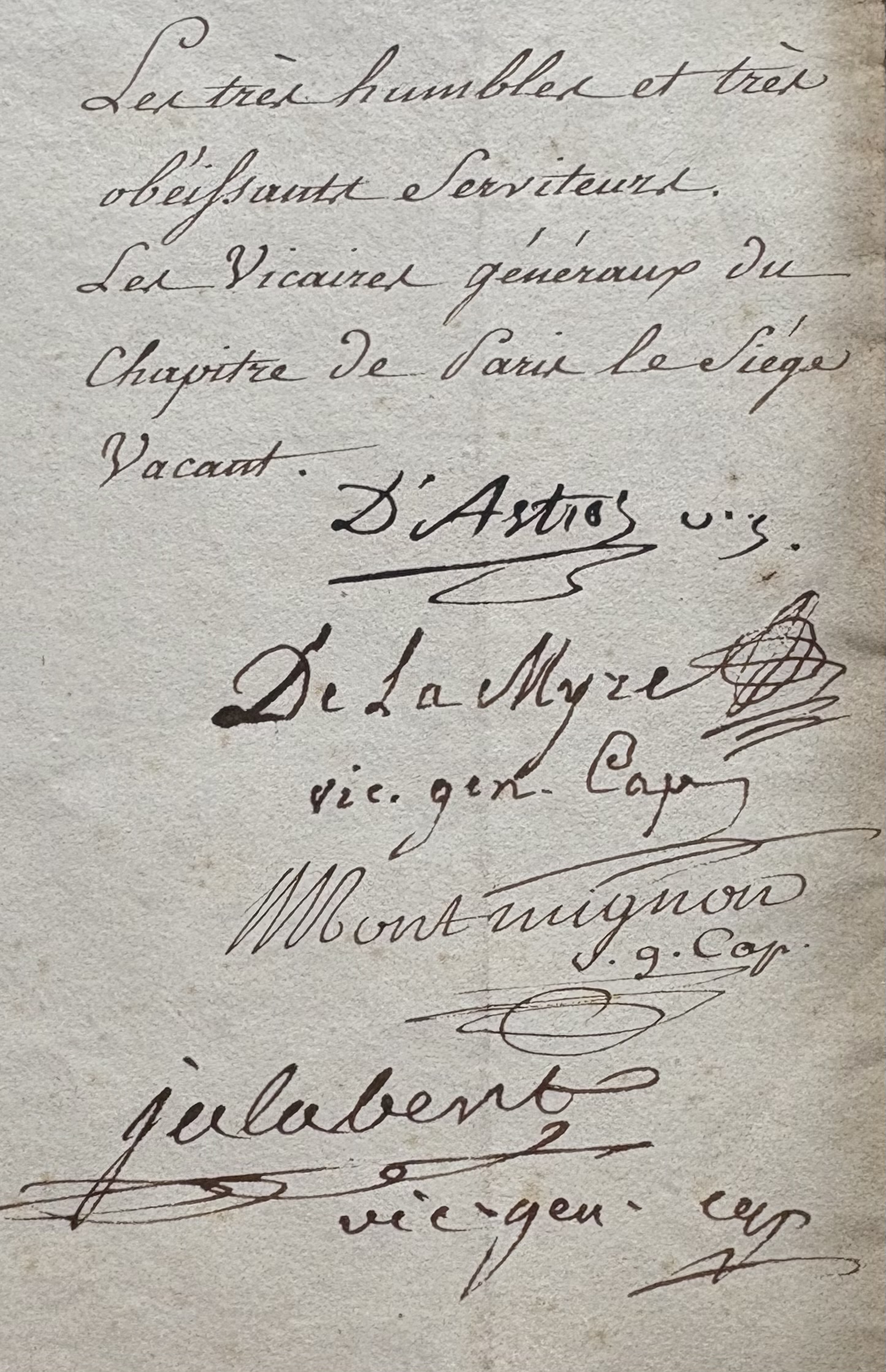
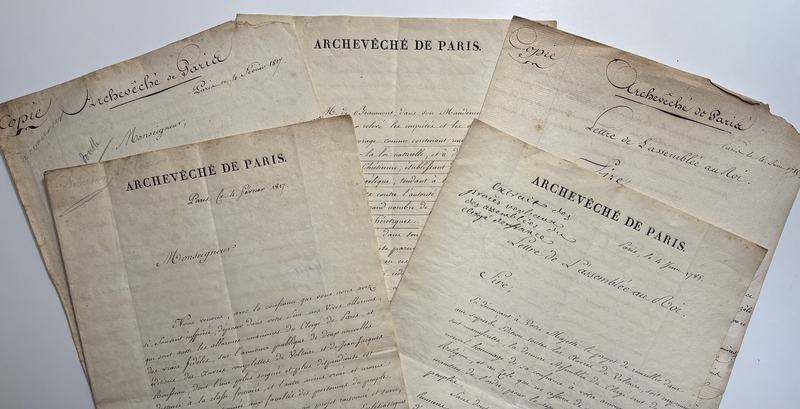
This collection of manuscript letters documents an attempt by the Archevêchè de Paris, to block the publication of new editions of the collected works of Voltaire and Jean-Jacques Rousseau, an effort duly circulated in 1817 in the Mandement de Messieurs Les Vicaires Généraux du Chapitre Métropolitain de Paris… pour le Saint Temps de Carême (or “Pastoral Letter of the Vicars of Paris, for Lent”). The contents and verbatim passages appearing in our manuscripts confirm a direct and explicit connection with the Mandement. The paper stock, letterhead, watermarks, and handwriting make the case that these documents were prepared together in 1817, at the time of the publication of the Mandement, confirming their relationship to the effort to censor the publications of Rousseau and Voltaire. The published version of the Mandement backfired, spawning sales for the publishers of the philosophes and a satire of the clergy, one that Victor Hugo would eventually draw on for Les Misérables [a work the Church added to the Index in 1864; see: Seville, Izquierdo, 1866. p.191].
A detailed description is here: Mandement de Messieurs les Vicaires Généraux de Paris (1817)
These manuscript documents show the efforts of the clergy to respond to the power vacuum that existed in France after the fall of Napoleon in 1814, and the return of the Monarchy and the Church to power. That Voltaire and Rousseau should continue to represent a threat to the authorities speaks to both the prescience and the longevity of the two writers, as well as to the clergy’s failure to learn from previous experience.
Mandement de Messieurs Les Vicaires Généraux… de Paris, 1817
The 1817 publication that followed our manuscripts was addressed to the clergy broadly in a post-Revolutionary moment when the Church and the Monarchy have been reestablished. It laments of the state of contemporary France, which according to the clergy is a place where the Pope and the King have returned, but the people have not returned to God, and where, among other ailments, one finds that “the most frequented places of the capital are like a long public library, composed of obscene or impious works, whose titles and frontispieces captivate the passers-by, throwing into their eyes a subtle venom, which instantly cuts deep to the heart…” p. 18.1
A new and profound calamity, planned in secret: Voltaire and Rousseau
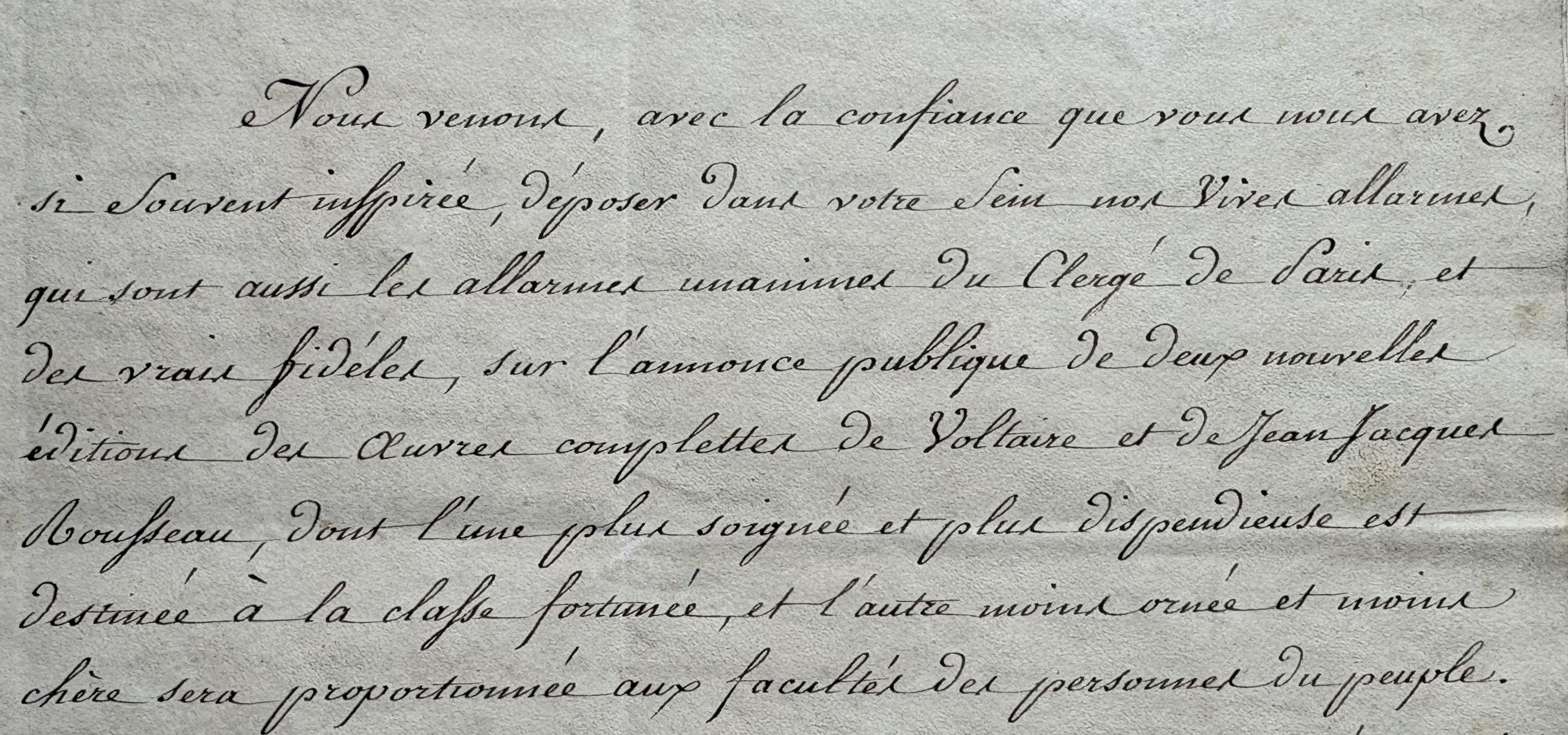
At the center of the Mandement is the warning of a coming calamity, the planned publication of the collected works of Voltaire et de Jean-Jacques Rousseau: “two collections of the complete works, without omission, of Voltaire and Jean-Jacques Rousseau. One, more magnificent, is intended for opulent readers; the other, less expensive, is prepared for the common people.” Adding that “[All of Europe is invited to subscribe…]” (pp. 19-20).
The faithful are beseeched: “to repel these infernal productions, to snatch them from the hands of your children, to deliver them to the flames, and above all not to be immersed in the modern and frightful plot of the new editions.”
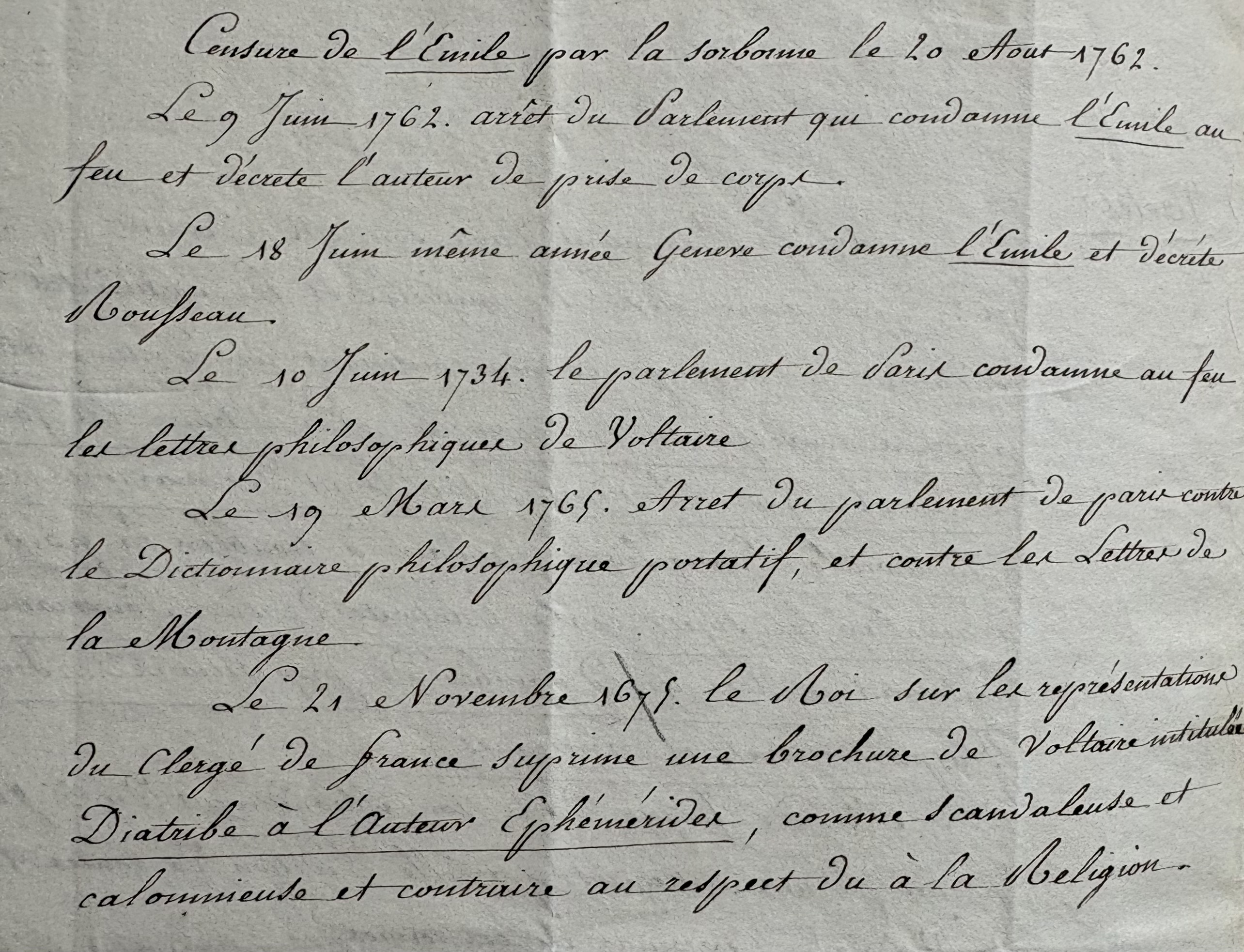
The Mandement uses as precedent the censorship of Voltaire and Rousseau prior to the Revolution, providing in a long footnote (pp. 31-32) a summary of efforts to stop their publication, including the condemnation of Voltaire’s Lettres Philosophiques (1734), Rousseau’s Émile (1762), Voltaire’s Dictionnaire Philosophique (1763), etc. The Mandement attributes France’s moral decay to the philosophy of Rousseau and Voltaire and appeals to the clergy and the faithful “de repousser ces productions infernales , de les arracher des mains de vos enfans , de les livrer aux flammes, et de ne pas tremper surtout dans le moderne et affreux complot des nouvelles éditions” (p.34).
The response of Béranger, Desoer, and… Gavroche!
The public reception of the Mandement was met with enthusiasm and humor, in favor of the philosophes. The French poet and chansonnier, Pierre-Jean de Béranger, responded with a satirical song whose immortal refrain, “C'est la faute à Voltaire... C'est la faute à Rousseau” was taken up by Gavroche in Victor Hugo’s Les Misérables, they are the words he is singing when he receives his fatal blow (vol. 9, p. 124. Paris, Lacroix, 1862).
Voltaire’s publisher, Théodore Desoer, responded with a 25-page pamphlet, Lettre de l'éditeur des Œuvres complètes de Voltaire en douze volumes in - octavo à MM . les vicaires - généraux du chapitre métropolitain de Paris , au sujet de leur dernier mandement” in which he accuses the clergy of overstepping their authority, defending both Voltaire and Rousseau as virtuous philosophers, mocking the Mandement’s style, its erroneous chronology concerning Voltaire’s apotheosis (i.e., his entombment in the Pantheon), and defends the resulting success of his “economical, commercially useful reprint.”
The great Voltaire scholar Georges Bengesco has written that, “The Mandement issued by the vicars-general of Paris, by drawing public attention to the Desoer edition, contributed to its success—and even its popularity—while the resurgence of an intolerant spirit within the clergy throughout the Restoration period played a part in the publication of a great many [such works].” (Bengesco, Bibliographie, vol.4, p. 150).
[1] Les lieux les plus fréquentés de la capitale sont comme une longue bibliothèque publique, composée d'ouvrages obscènes ou impies, dont les titres et les frontispices captivent les passans, et jettent dans les regards un venin subtil, qui , à l'instant même, se communique au coeur.