Directions for sailing ships: three 18th cen. documents

Safely navigating the sandbanks and shoals of the English coast in the 18th century
Three rare survivors, one of which untraced in libraries, documenting 18th cen. sailing conditions in England: two for navigating dangerous shoals along the east coast—the Goodwin Sands in the south and the Haseborough Sand in the north—and an Act (1791) for the better Regulation and Government of Seamen.
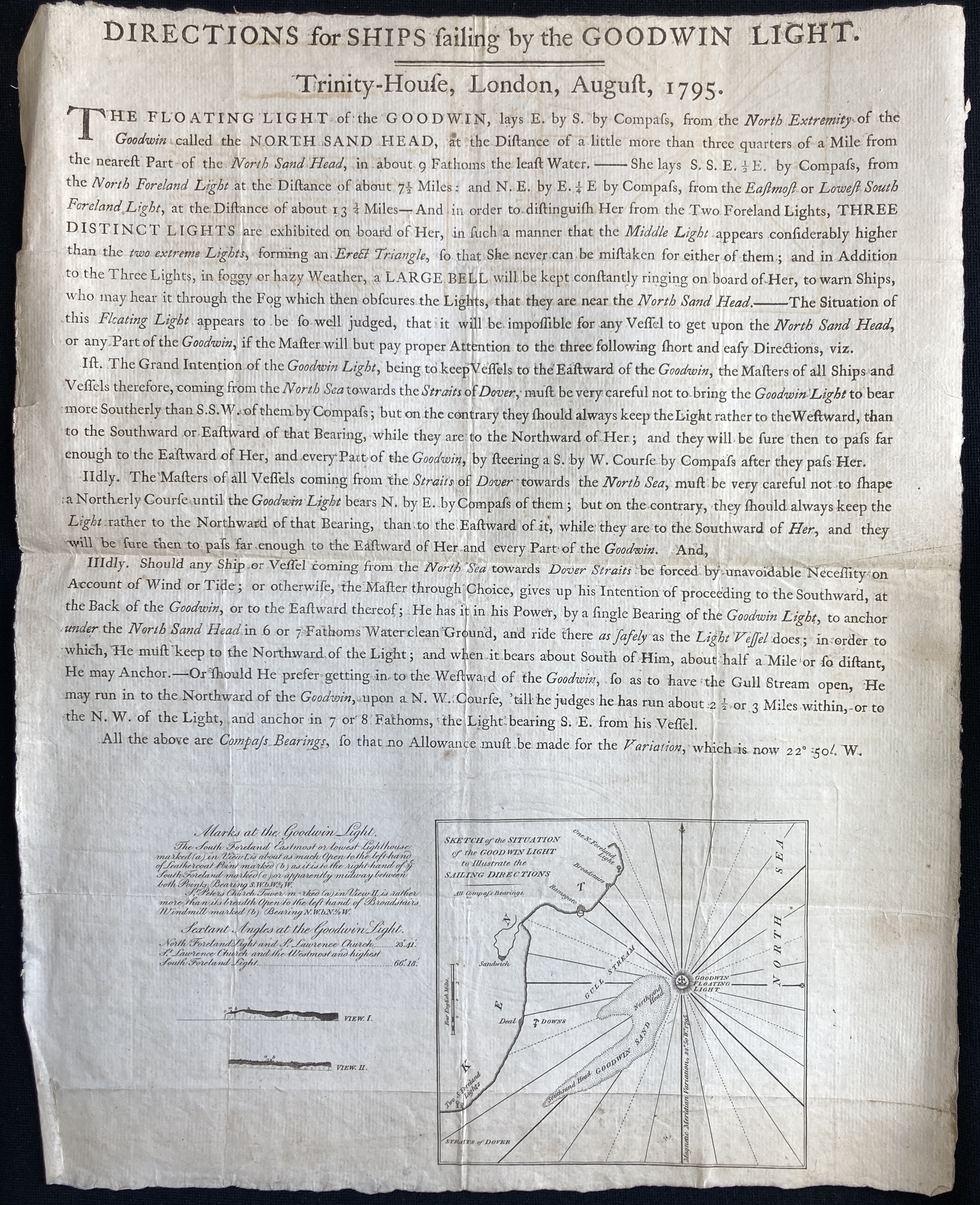
1). Directions for ships sailing by the Goodwin Light
Trinity House, London, 1795
(41.7 x 33 cm). Broadside leaf printed on one side only. Letterpress text and an engraving. Some minor soiling and fold lines. A rare and precious document which must have saved innumerable ships from running aground.
ESTC: Nat. Archives UK (2 copies); no others traced.
The first documentation of the Goodwin Light ?
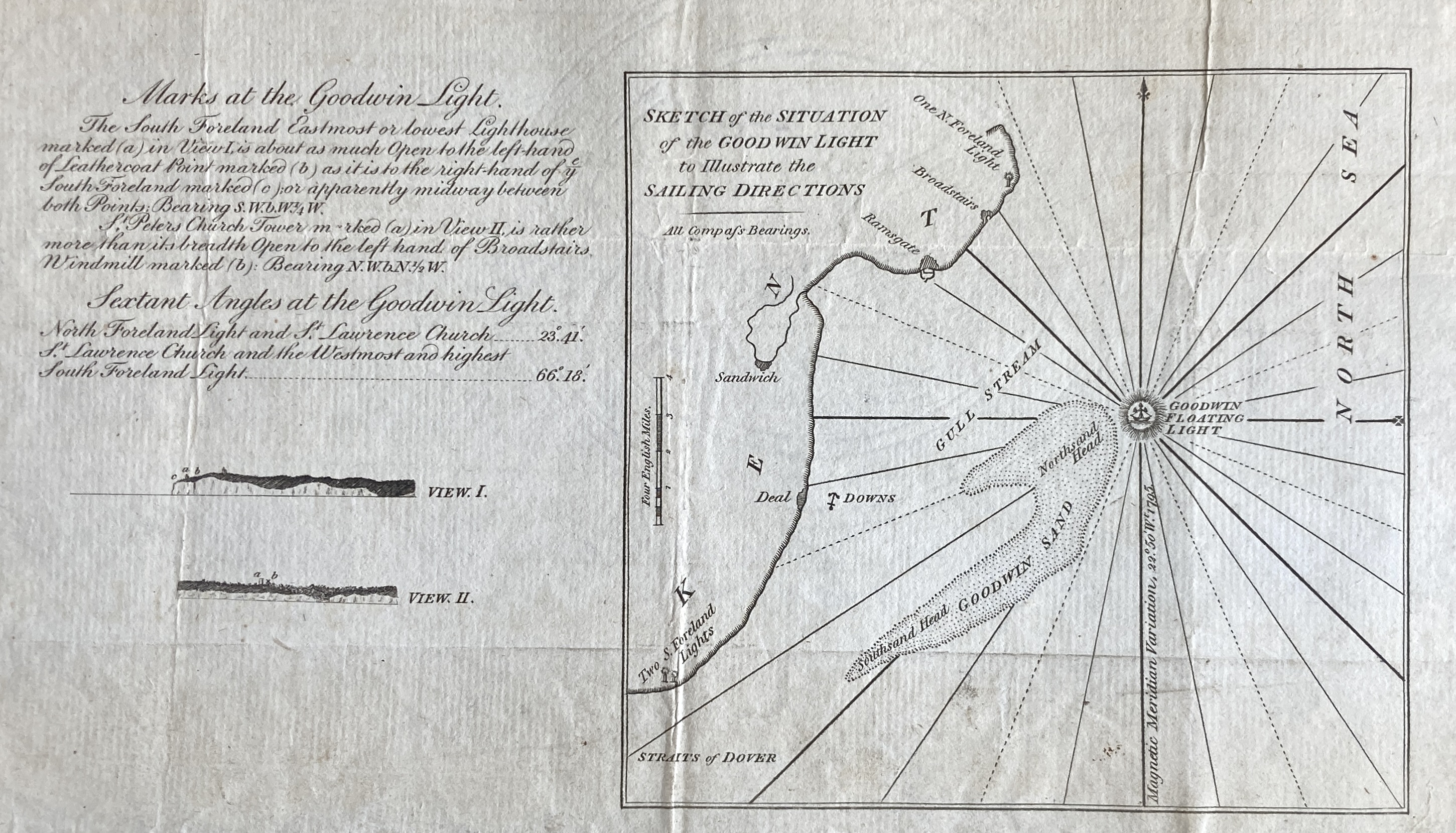
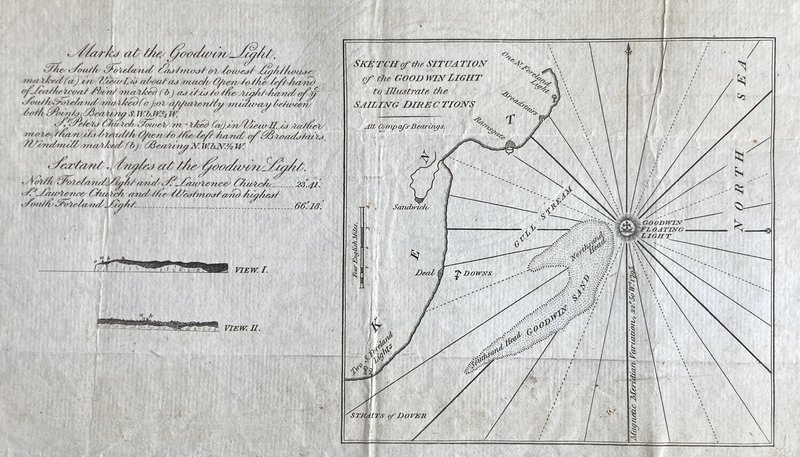
This document, published by the lighthouse authority Trinity House in the year that the Goodwin Light was first established (1795), provides detailed instructions for ships sailing along the English coast for navigation around the Goodwin Sands, a 10-mile long sandbank, by way of reference to the Goodwin Floating Light, six miles offshore to the east of Deal and southeast of Ramsgate. The document gives precise sea depths, visual descriptions, and sailing instructions for safe passage through the shallow water and sandbars of the Goodwin Sands. A navigational map complements the instructions and includes exact sexton coordinates for the Goodwin Light. These dangerous shallows have claimed as many as 2,000 ships over time—this document would have saved many ships from running a ground.
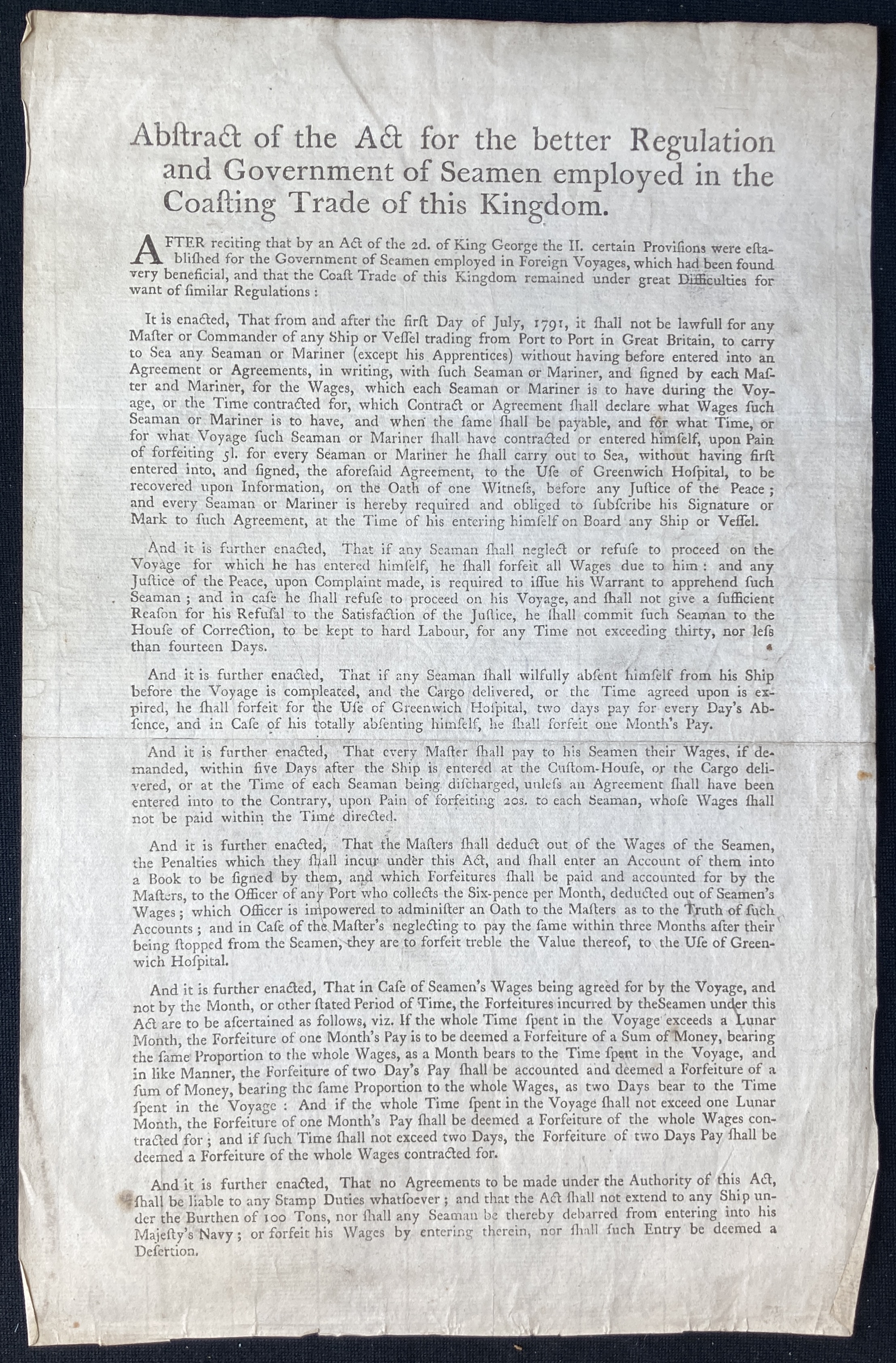
2). Abstract of the act for the better regulation and government of seamen employed in the Coasting Trade of this Kingdom. [London, 1791]
(37.4 x 24.5 cm). Folio half-sheet. One leaf printed on one side only. Fold line and minor soiling. No copies located, including ESTC.
The abstract summarizes the following regulations: that all Commanders and sailors must have a signed written agreement in place before leaving harbor ; the penalties for any sailor who neglects or refuses to follow through on said contract ; penalties for any sailor who willfully absents himself from service before the contracted journey’s termination ; a requirement for Commanders to make timely payment of wages to sailors ; a requirement for Commanders to document in writing any penalties against a sailor’s wages ; the regulations for the manner in which a sailor’s wages may be reduced with consideration for the duration of their contract for a given voyage and other forfeitures according to the agreement between the Commander and the sailor ; and finally, the conditions of the present Act regarding Stamp duties, ships under 100 tons,and the rights of sailors who enlist into His Majesty’s Navy. The Act was passed in the 17th Parliament of Great Britain, 6 June 1791, as citation 31 Geo. 3. c. 39.
3). Instructions for sailing in and out of Happisburgh, commonly called Haseborough Gatt.
[c.1791 (date given from a note in the document’s final paragraph.)]
(40 x 26 cm). Folio. Single sheet folded once, 3 pp. (final blank). Some surface soiling, but otherwise an excellent copy. 2 copies known, BL and Sutro.
Safe sailing through shallow water:
These instructions for sailing safely in and out of Happisburgh include detailed coordinates and descriptions of the various sandbanks and shoals off the coast of Norfolk. Included are details regarding the size, location, characteristics of the sandbars, and sea depths around Haseborough Sand, the Ridge Sand, Smith’s Knoll, the Newarp Sand, as well as the tide patterns in the area, and finally the instructions for sailing safely in and out of the Gattway, with reference to lighthouses and floating lights. The document ends with a chart of Bearings and Distances of sundry points so that ships may navigate with the greatest safety.
The instructions for navigating these dangerous waters are concise and the chart for Bearings and Distances would have been invaluable to sailors as they made their way along the British coast.
Three rare survivors of sailing documents, whose practicality would have led to heavy use, no doubt accounting for their rarity.