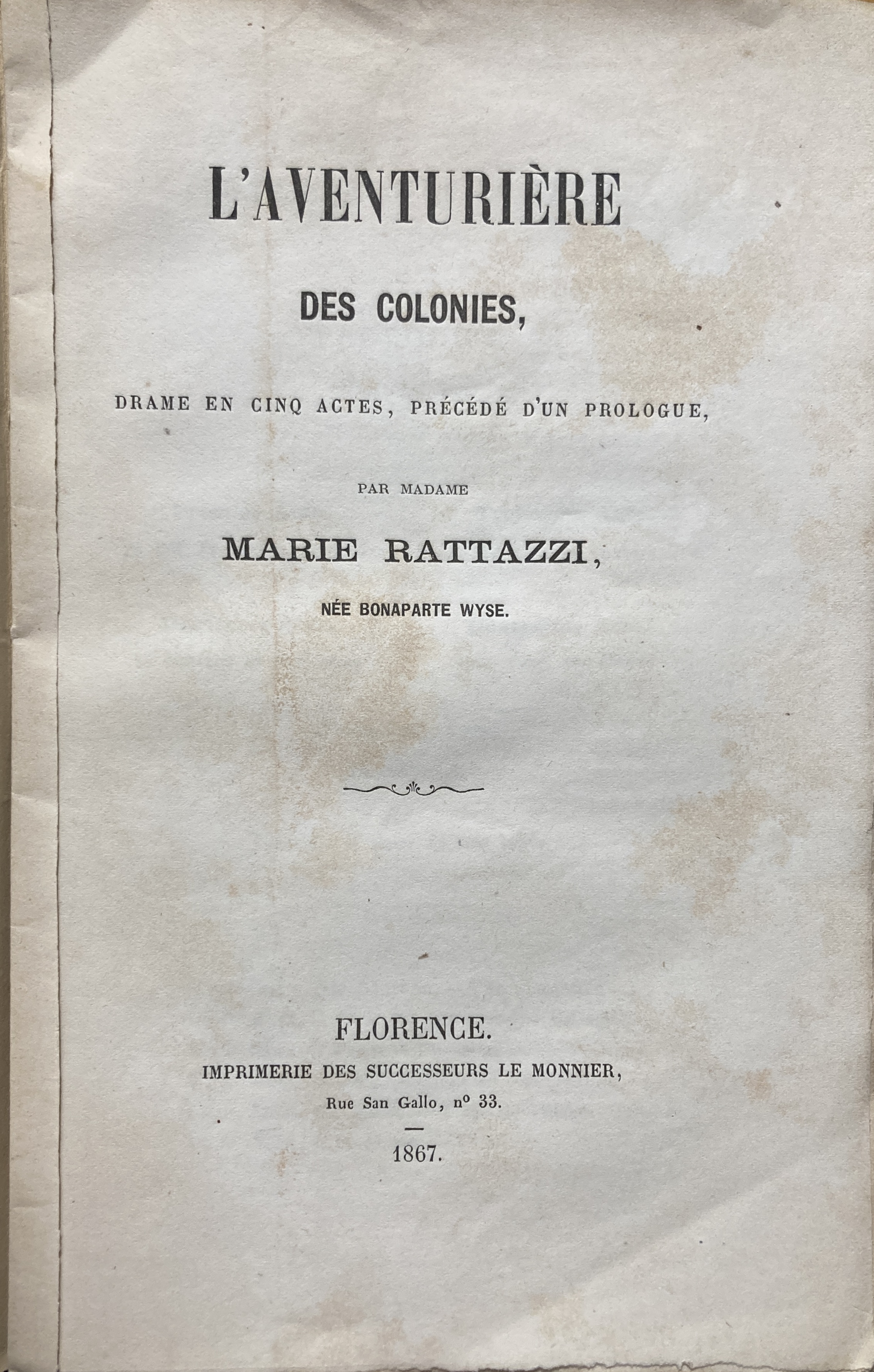
Marie-Laetitia RATTAZZI. "L'AVENTURIÈRE DES COLONIES, drame en cinq actes, précédé d'un prologue."
FULL DESCRIPTION: Rattazzi
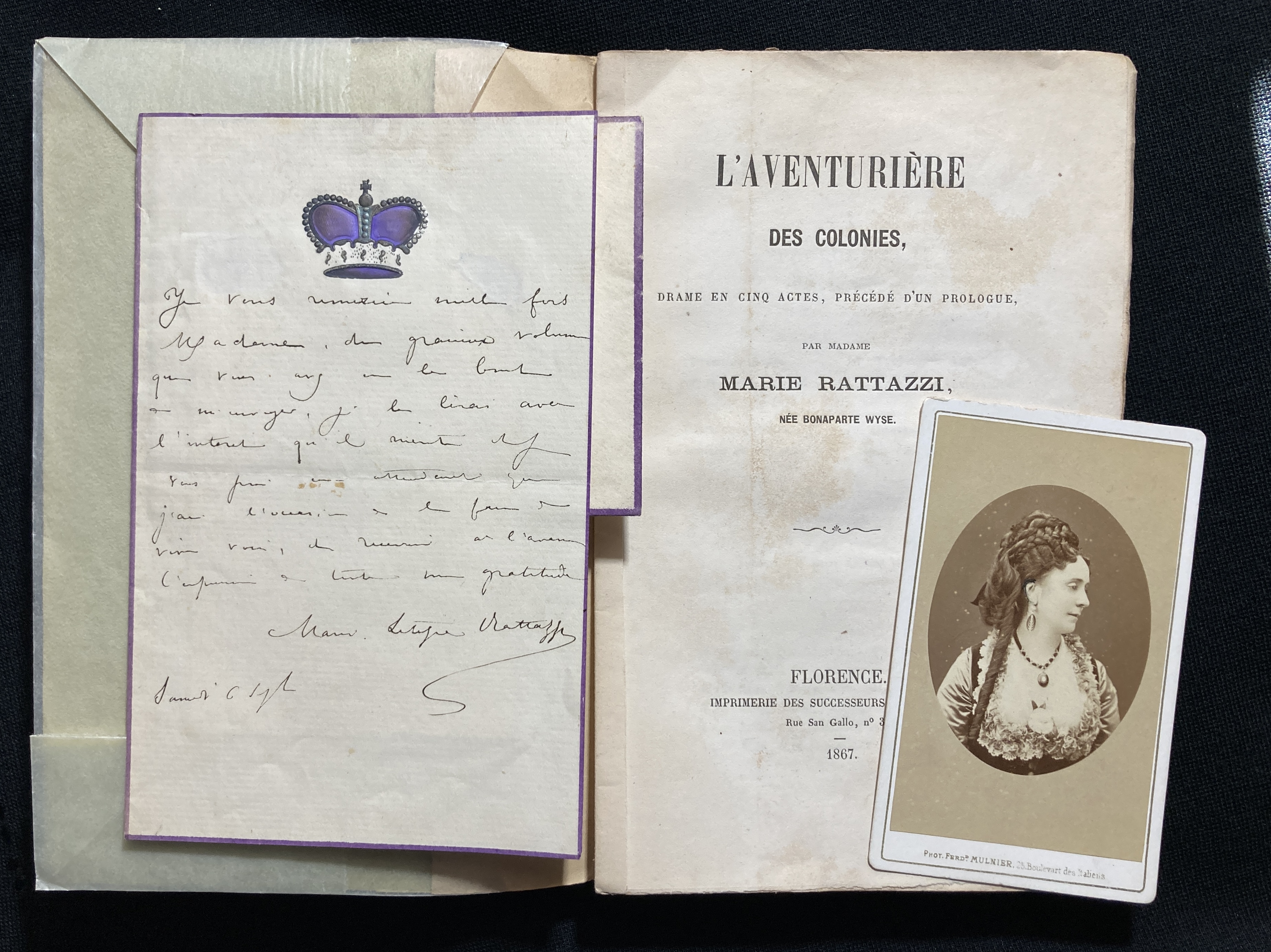
RATTAZZI (Marie-Laetitia). L'Aventurière des colonies, drame en cinq actes, précédé d'un prologue.
Florence, Imprimerie des successeurs de Le Monnier, 1867.
(18.5 x 12 cm). [3-7] 8-201 pp. Publisher’s printed wrappers with some scattered spotting, lacks the half title [1-2]. A nice copy of a scarce book.
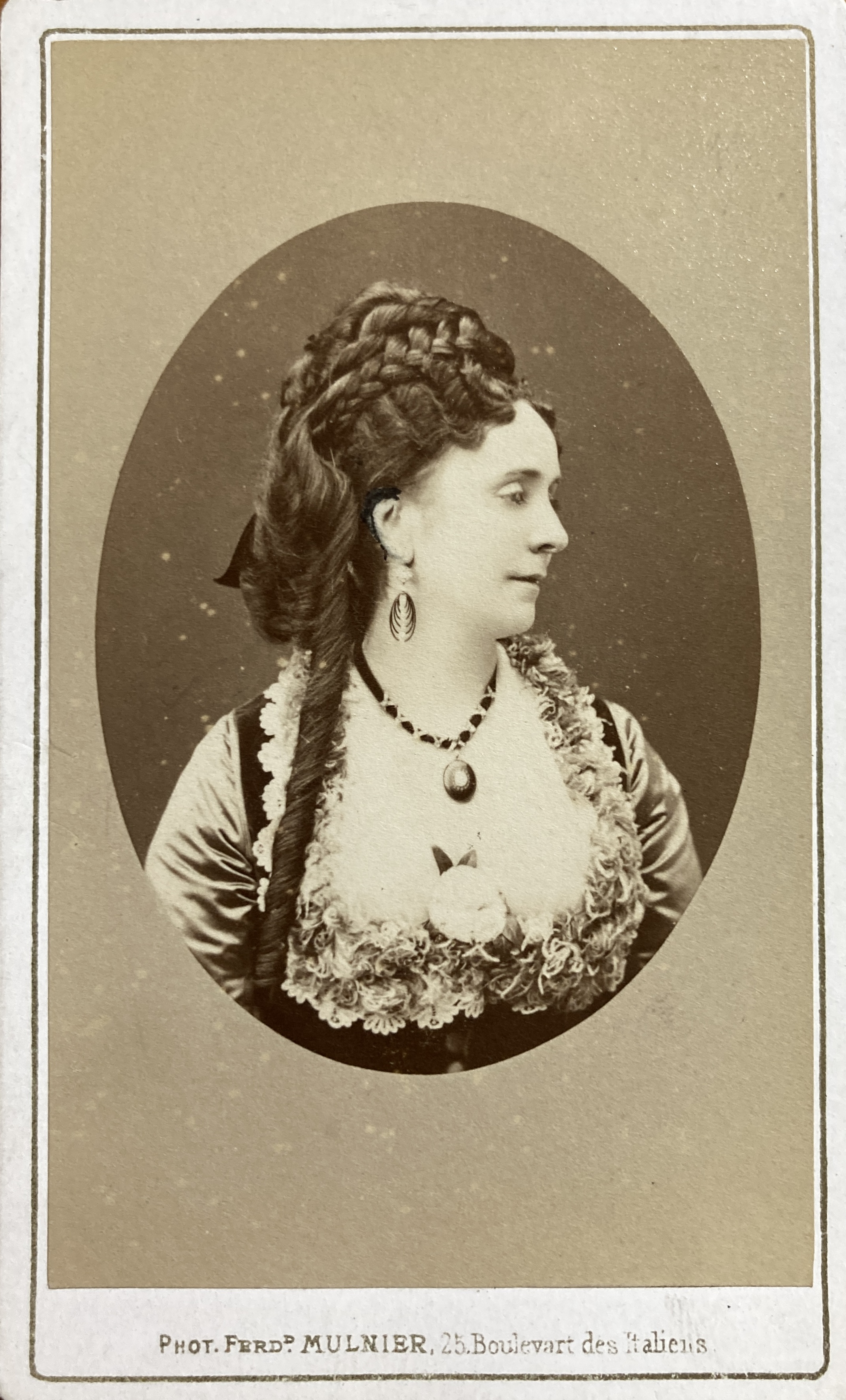
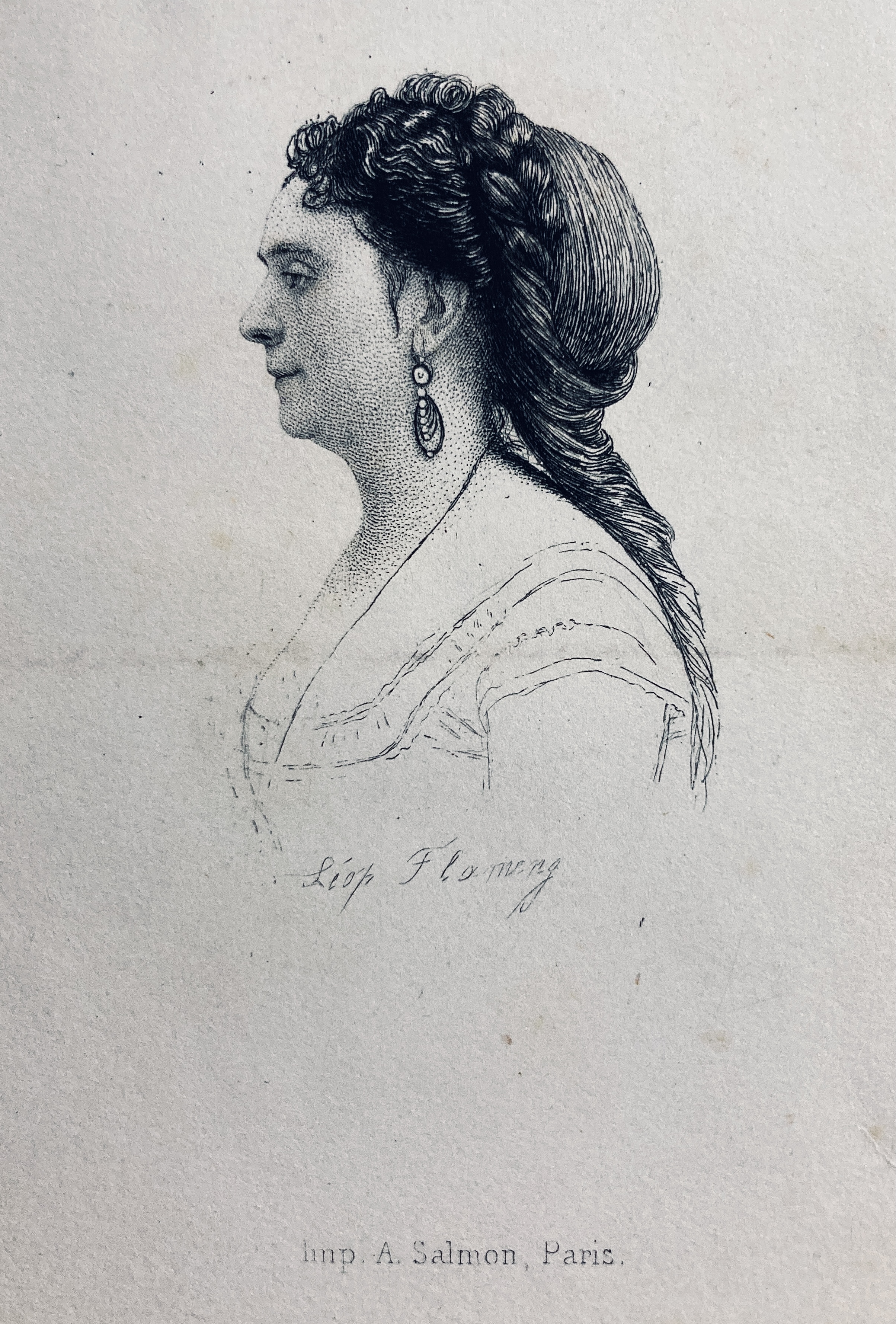
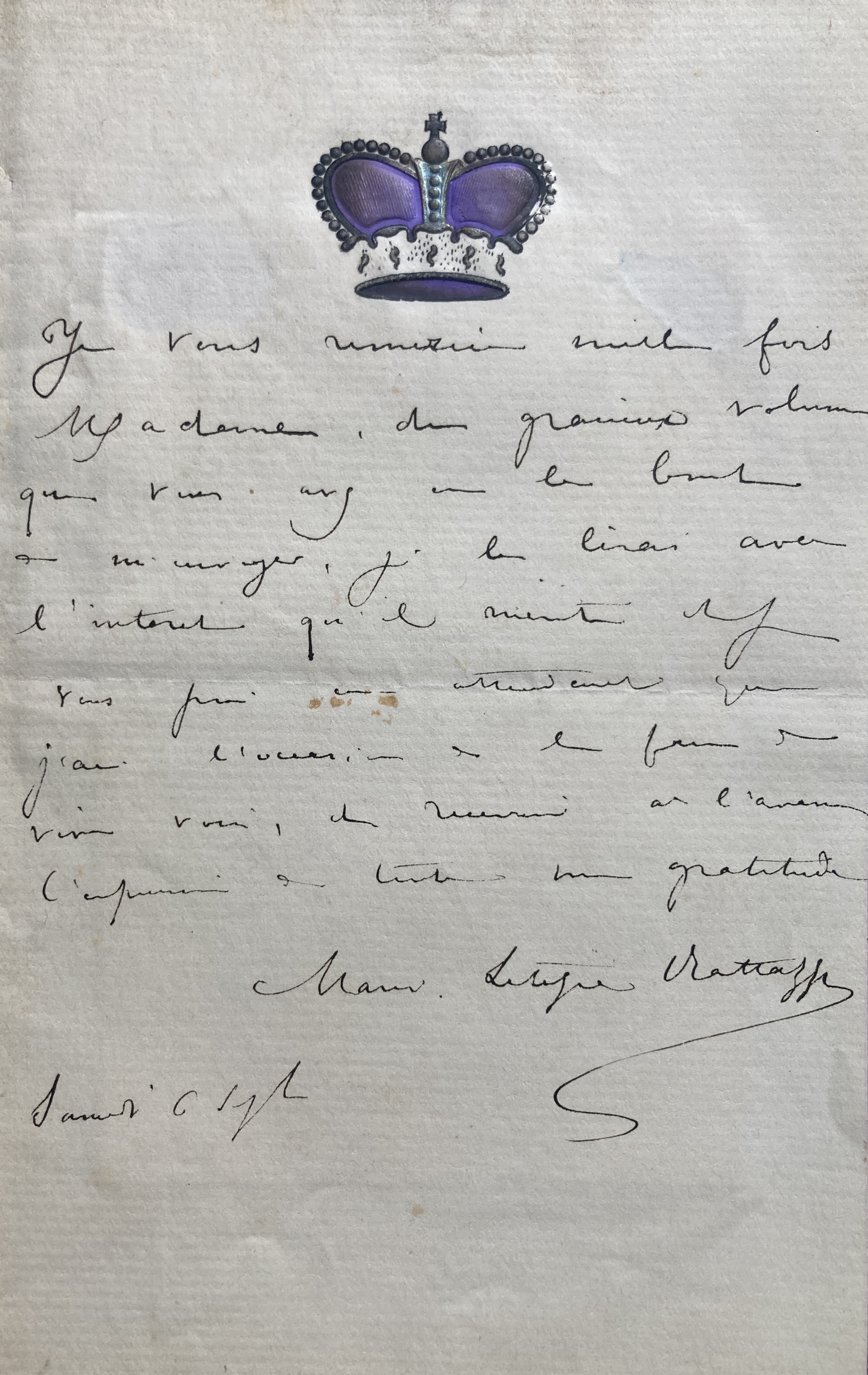
Laid-in: ALS from Rattazzi to a fellow writer, an engraved portrait (printed by the renowned Atelier Salmon), and a carte-de-visite (Mulnier). Ex-libris Ryckebusch.
Exiled by her cousin the Emperor Napoleon III for her roman à clef :
This five act play by Marie Rattazzi is based on her early novel, Les Mariages de la Créole , which was banned in France by Napoleon III, the author’s cousin, but published in Brussels, 1866. Rattazzi’s narrative is in fact a roman à clef based on the affair of Eugène Schneider, an industrialist, banker, politician, and ally of Napoleon III, and Marguerite Asselin [Magarthy in the play], his Creole mistress, and the marriage of Schneider’s son to Asselin’s daughter. After the banning of the novel, production of the play in France was impossible, so Rattazzi adapted it for the Italian stage while in exile there—published in Florence, for the present edition, then translated into Italian (Naples, De Angelis, 1868). A second edition was published in Paris, 1885.
“The prologue of the play opens on a plantation on the Île Bourbon where Magarthy, a quarteronne slave, schemes to marry her master and lover, le Comte de Cerny. When he discovers she has caused his wife’s death, Magarthy escapes with another lover, the slave trader John Bradston. In act one, Magarthy has reinvented herself as the Baronne de St. Denis but is not content as a demi-mondaine in Paris. She needs a legitimate husband to make her appear honest and frequentable in the eyes of le monde…” (cf. Sullivan, 19th Century Studies, 2022).
The play not only critiques Second Empire prejudices related to race, gender, and social class, but also the “deceit, betrayal, hypocrisy” that characterizes the action of this drama. Both narratives—the salacious tale on which the novel/play was based and the intrigues around their publication—could have been penned by Alexander Dumas, père or Eugene Sue. Razzatti was in fact close to both of her fellow writers, having a romantic liaison with the latter while the former is said to have transcribed the text of her novel by hand while she was adapting it for the stage.
The author Marie-Laetitia Bonaparte-Wyse (1831-1902), was the daughter of Laetitia Bonaparte-Wyse, herself the daughter of Lucien Bonaparte and Alexandrine de Bleschamp, led a whimsical life as an aventurière of letters, a prolific writer who occasionally took “Baron de Stock” or “Bernard Camille” as noms de plumes. She was banned from Paris by her cousin Napoleon III in 1852, who suspected her of plotting, and again after the controversy of her novel in 1865-6. Married in 1848 to Frédéric-Joseph de Solms, then in 1863 to the Italian minister Urbano Rattazzi, and finally to the Navarrese Don Luis de Rute y Gines, she had an adventurous love life as well (including a liaison with Eugène Sue).
ALSO INCLUDED:
An autograph letter signed (1 p.) to Madame Marie Cellini, addressed to the Casino in Trouville, written on Rattazzi’s crowned stationery and envelop, to thank Cellini for sending her a book, “le gracieux volume” [likely Cellini’s Toute une vie, 1872] that “Je le lirai avec l'intérêt qu'il mérite et je vous prie en attendant que j'aie l'occasion de le faire de vive voix, de recevoir [...] l'expression de toute ma gratitude [I will read it with the interest it deserves and I beg you, until I have the opportunity to do so in person, to receive [...] the expression of all my gratitude].” Pasted to the verso of the letter is an engraved portrait of Rattazzi, printed at the Atelier Salmon, Paris. The carte-de-visite is by Ferdinand J. Mulnier.